Monday, 18 June 2012

North Downs Walk: Westhumble and Ranmore Common

View from North Downs Way near Ranmore Common
This is another walk in the Box Hill area, with the same starting point as last year's walk to Box Hill, but exploring the west side of the Mole valley. In the description below, grid references were obtained from UK Grid Reference Finder and the points can all be displayed here.

Starting at Box Hill and Westhumble station, turn left and head up the hill over the railway bridge, bearing left onto Chapel Lane. Just after Pilgrims Way turn left onto a footpath at TQ 16517 51855 [B].

Follow this, crossing one road along the way, eventually reaching a kissing gate into a field. There's a second gate immediately ahead, pass through this to meet the North Downs Way at TQ 16358 51446 [C].

Joining the North Downs Way

Turn right on to the North Downs Way, and follow this all the way to Ranmore Common. Along the way, there are good views of Denbies Vineyard to the left, initially with the Mole Valley and Box Hill beyond, and then as the path bears to the right and emerges from the trees, Dorking and Westcott.

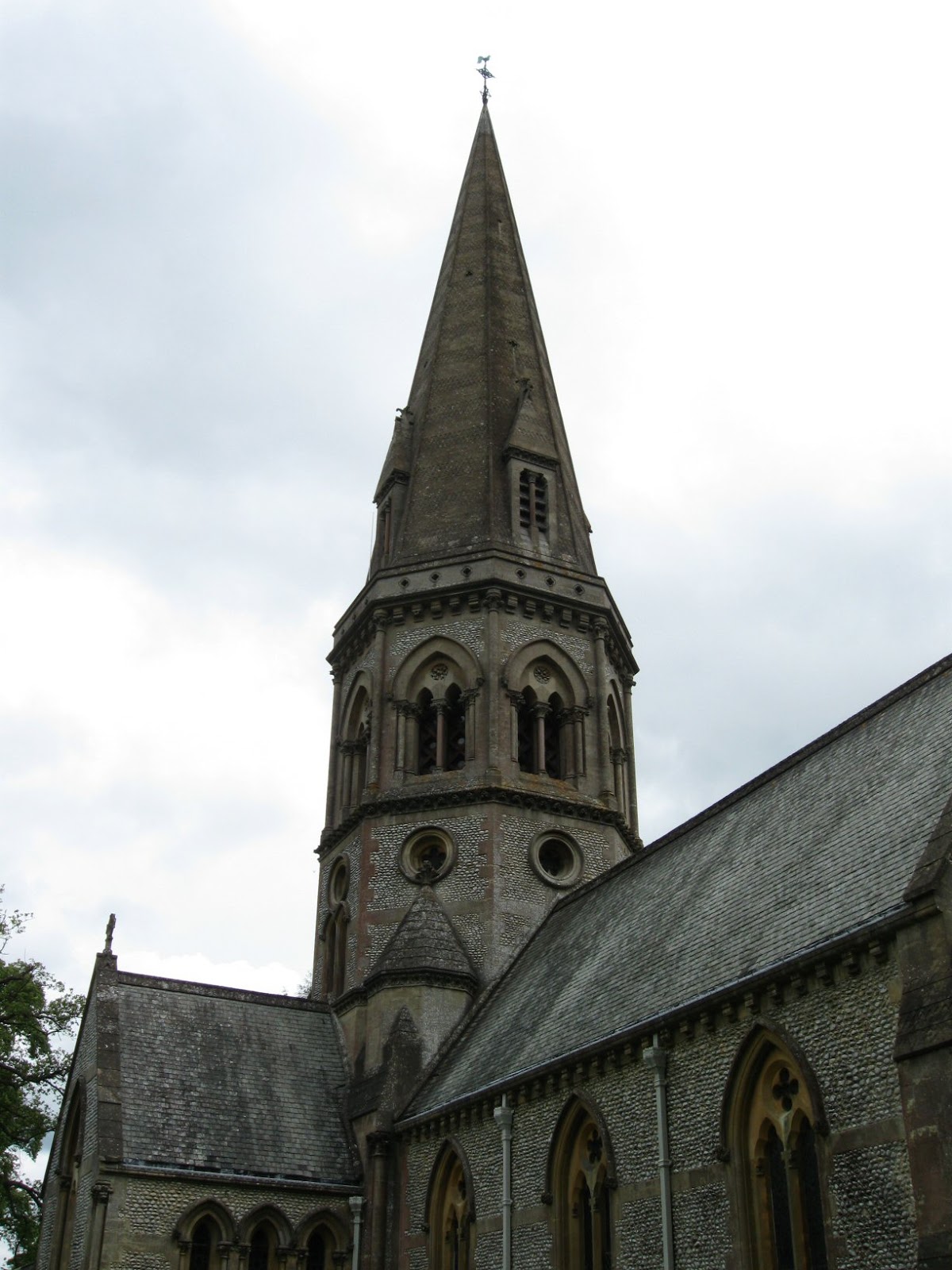
Church of St Barnabas
The surface is easy walking for most of the way, and soon becomes a tarmac road - watch out for the Denbies Vineyard tour "train", pulled by a Land Rover.

Follow the North Downs Way as it turns right at TQ 15124 50529 [D] and left at TQ 15091 50691 [E] on to Ranmore Common Road. Follow this, and if time permits spend a while looking at the Church of St Barnabas on the left.

Ranmore Common Road emerges from the trees at a junction at TQ 14355 50369 [F], the North Downs Way continues on the other side of the road - look for the footpath post immediately opposite.

Follow the path around to the right, and then straight ahead into the trees. There are further good views of the valley over to the left.

Ranmore Common
Immediately after the gate at the Forestry Commission sign at TQ 13991 50275 [G], take the footpath backwards and to the right, which soon bears left and leads back out to the road. Cross the road and head left, a footpath post is visible on the right hand side at TQ 13897 50458 [H].

There are in fact three paths leading away from here, this walk takes the middle one, signposted for the Youth Hostel at Tanner's Hatch. At the Youth Hostel, follow the path round to the right at TQ 14009 51552 [I].

Soon after emerging from the trees, there is a junction of paths at TQ 14423 51730 [J]. At this point, it is possible to branch off and visit Polesden Lacey, see the note below for this extension.

Bear right across open land to Bagden Farm, and then left to meet Chapel Lane at TQ 14802 52093 [K]. From here, follow Chapel Lane back towards Westhumble. Note that the lane is winding and narrow, and
difficult in places, but it is nevertheless possible to walk straight back into Westhumble this way.

Alternatively, take a right turn on to Ranmore Common Road, and then take the footpath off to the left at TQ 15246 51946 [L], following this upwards and keeping to the left - the footpath continues across a style and alongside the edge of the trees. Cross another style and then follow the path as it bears to the right.

At the footpath junction at TQ 15871 51622 [M] turn left, and then look for the footpath on the right at TQ 16028 51856 [N]. Rejoin Chapel Lane, and follow it back into Westhumble.

Italianate Bridge
For the extension to Polesden Lacey (allow a minimum of one hour for this), instead of bearing right across the open land at TQ 14423 51730 [J], follow the path ahead and round to the left, heading uphill to the Italianate Bridge at TQ 14309 51974 [O]. Use the steps just beyond the bridge to the right hand side to reach the road and head towards the house and grounds.

Note that it is possible to enter the grounds from this road, by following it to the gate and entering at TQ 14209 51964 [P], but it is possible to access the visitor centre and facilities without buying a ticket for the house and grounds, there is a gate to the right at TQ 14248 51952 [Q] before reaching the boundary gate. Keep following this path around the boundary, through two gates at TQ 14067 52280 [R], bear left around the edge of the trees at TQ 13950 52481 [S] before finally meeting the entrance road at TQ 13699 52384 [T].

From there, the main entrance is ahead and on the left.

To rejoin the walk, head back to the Italianate Bridge, and continue on the road, which winds down to Bagden Farm. Pass through the gate to the left of the main gate and on to Chapel Lane.


Wednesday, 13 June 2012

Dave Gorman, Flickr, and the DMCA - Concluded

Update: Dave Gorman has a new blog post describing the conclusion to this saga.

On February 17th this year, Flickr deleted this photograph posted by Dave Gorman, following a Digital Millennium Copyright Act (DMCA) request from a company called Wasteland Inc. They basically told Flickr that they were the rightful copyright holders, and in response to that, Flickr deleted the image.

Dave Gorman is currently discussing this on his blog, and both the main post and the comments contain some fascinating insights:
  • He describes how he investigated the claim, found out more about Wasteland Inc. and then launched a counter claim which wasn't challenged
  • He talks about the damage done to the original upload because Flickr did not restore it with the original link, comments, and viewing statistics
  • He highlights the issues with the DMCA notification process
  • In the comments section, there is a contribution from the CEO of Wasteland Inc. which is a great example of how to respond swiftly to public criticism via social media channels
Read the full article here.

Thursday, 7 June 2012

Useful Reading on the LinkedIn Password Problem

Photo credit: Mario Sundar on Flickr
There's a lot been published on this over the last day or so, which means that there's not much point repeating it all, but I have seen some useful articles and blog posts which are worth sharing.

First up is to say that LinkedIn are providing updates on this, as they should, the latest one is here. This does mention "hashing" and "salting", and you can find out more about these terms in this short post by Peter Vidani.

You can get some advice on finding out if your password was compromised over at Avinash, this post includes a link to a tool that you can use, but as this involves typing in your password, make sure this isn't a password you're still using anywhere. You've changed your LinkedIn password anyway, haven't you? Haven't you?

Finally, Troy Hunt has some useful advice on managing your passwords generally, as well as dealing with this specific incident.

Monday, 4 June 2012

Use Buffer to Retweet into LinkedIn

In May, the team at Buffer announced some updates to their browser extension components which allow you to schedule Tweets from within twitter.com, and also to schedule retweets.

However, because of the way that the Buffer extensions work, this opens up a solution to the problem of Tweets piped into LinkedIn status updates becoming un-shareable on LinkedIn.

This is a problem I wrote about recently over on Social Mii so I won't cover it again in detail here, except to repeat one of the screenshots which describes the problem (click on all the images in this post to enlarge them):

The issue here is a lack of a LinkedIn "share" link when Tweets are piped directly into LinkedIn from Twitter.

The ability to schedule retweets using Buffer allows you to also share the update with other social media networks, including LinkedIn. Here's an example of the process in action.

We start with the Tweet we wish to retweet. As we have the Buffer extension installed, the twitter.com page now includes the "Buffer" link, along with the Buffer icon:


Click on the Buffer link, and the normal Buffer extension dialogue appears, with the original Tweet shown with the "RT @user:" retweet prefix. In this example, the addition of this prefix pushes the text to over 140 characters, which is too much for Twitter, so it does need to be edited down slightly.


Note that the Buffer accounts list include my Twitter and LinkedIn accounts, which means that this update will go to both social networks. Click "Add to Buffer", and the post will be added.

We now check the Buffer schedule and find both the Twitter and LinkedIn updates are in place:


One other thing to add is that the LinkedIn share allows for additional information to be displayed from any link included in the Tweet, and although Buffer supports this, it isn't included here. However, all is not lost, as we can now edit the LinkedIn item by using the "edit this post" button in Buffer. We only need to make a minor change to the text (such as adding a space) and Buffer will go off and fetch the additional information, and update the post:


So now we can effectively and quickly retweet from Twitter into other social networks, including LinkedIn, and once in LinkedIn, our updates can be easily shared by others in our network:


Tuesday, 29 May 2012

Development Environment Must-Haves: Development and Test

For any serious development environment, creating properly partitioned development and test environments is essential. Let's work backwards from production, and look at our expectations when we deploy to each environment.

Photo credit: gothopotam on Flickr

In production, we expect and demand nothing less than correct operation when we deploy a new version of our application. We expect this environment to be permanently available. If there are any problems, they must be specific to the production environment only. We can reduce the probability of this occurring by using a "regression" or as-live environment.

In regression, we know that our application has been fully tested, but we expect to encounter problems related to configuration changes or perhaps database versioning issues. We expect this environment to be permanently available as production, but accept there may be problems from time to time. By encountering these in regression, we are able to address the issues before our application makes it into production. We make sure that our application is performing as per specification and that there are no defects, by using a system test environment.

In system test, we know that our application works, in that it starts up and functions, however business functionality and overall operation has not been independently tested. We expect this environment to be generally available during testing, but accept that new releases may bring in problems which have to be addressed, and also that the application may fail during testing due to major defects. We expect to encounter these issues as well as some relating to the configuration of the environment and resources it uses, such as databases. However, we can have confidence that our application basically works, by using a development environment.

In development, nothing is guaranteed. The application may or may not work, for reasons which will be investigated by development staff. The development environment is used to ensure that released applications are basically sound, and configuration issues explored. We expect this environment to be generally available, but accept that certain tasks during the development phase may require it to be extensively rebuilt or reconfigured.

Applications (as created by your continuous integration build cycle) should be released to each environment in turn, and where problems are found, be prepared to back track and rework - and start the cascading release process again once the fixes are in place.

If you ever find yourself deploying to production and changing the production database because of a bug or change to requirements, and then back-propagating to development, you have a major problem!

In this short series I'm outlining the tools you really do need for a professional quality software development environment. Many of them will seem like common sense to many of you. Many of them have been inexplicably missing from development environments I've seen over the past few years. The list isn't meant to be "the final solution" - you may have these things, you may have alternatives, you may have nothing at all - in which case you know where to start.

Wednesday, 23 May 2012

Running Competitions on Pinterest


Briers Home & Gift Web Site

Vancouver retailer Briers Home & Gift is running a competition using Pinterest, until the end of June. You can enter by pinning items from their online store catalogue on to your Pinterest board and then submitting the pin URL on the Briers web site.

What's interesting about the competition is that it has multiple streams, using a combination of random draws of pins (weekly, and at the end of the competition), a tally of re-pins and likes for each pin submitted, and the good old judges-decision-is-final who can create the coolest board on Pinterest.

The downside, perhaps, is that the entry process is a bit clunky - pinning is of course quite quick, but the form filling process afterwards is more fiddly. I'm sure there's some scope for a bookmarklet or similar time-saving tool to be created to help with this... I may have my coding hat on later in the week.

You can find out more and watch the video on the Briers web site. The competition is open to anyone, anywhere in the world, so it's worth taking a look not only to see how they're doing it, but also to take part!


Monday, 7 May 2012

LinkedIn Usage Patterns Emerge

There are virtually no changes to the usage pattern for connections in my LinkedIn network during April 2012, on a network which grew only very slightly over the month.

I'm expecting this to settle into a regular pattern, showing that the majority still use LinkedIn for growing their networks rather than interacting with them, although I would also expect this to change over longer timescales as more people learn how to make better use of LinkedIn.

Click on the link below the summary chart to see the full page, with charts created in HTML5 using RGraph.
Click to view full size