In May, the team at Buffer announced some updates to their browser extension components which allow you to schedule Tweets from within twitter.com, and also to schedule retweets.
However, because of the way that the Buffer extensions work, this opens up a solution to the problem of Tweets piped into LinkedIn status updates becoming un-shareable on LinkedIn.
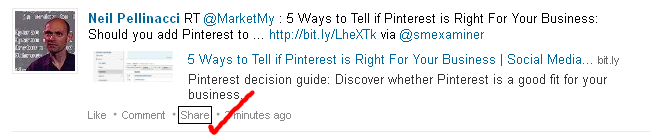
This is a problem I wrote about recently over on Social Mii so I won't cover it again in detail here, except to repeat one of the screenshots which describes the problem (click on all the images in this post to enlarge them):

The issue here is a lack of a LinkedIn "share" link when Tweets are piped directly into LinkedIn from Twitter.
The ability to schedule retweets using Buffer allows you to also share the update with other social media networks, including LinkedIn. Here's an example of the process in action.
We start with the Tweet we wish to retweet. As we have the Buffer extension installed, the twitter.com page now includes the "Buffer" link, along with the Buffer icon:
Click on the Buffer link, and the normal Buffer extension dialogue appears, with the original Tweet shown with the "RT @user:" retweet prefix. In this example, the addition of this prefix pushes the text to over 140 characters, which is too much for Twitter, so it does need to be edited down slightly.
Note that the Buffer accounts list include my Twitter and LinkedIn accounts, which means that this update will go to both social networks. Click "Add to Buffer", and the post will be added.
We now check the Buffer schedule and find both the Twitter and LinkedIn updates are in place:
One other thing to add is that the LinkedIn share allows for additional information to be displayed from any link included in the Tweet, and although Buffer supports this, it isn't included here. However, all is not lost, as we can now edit the LinkedIn item by using the "edit this post" button in Buffer. We only need to make a minor change to the text (such as adding a space) and Buffer will go off and fetch the additional information, and update the post:
So now we can effectively and quickly retweet from Twitter into other social networks, including LinkedIn, and once in LinkedIn, our updates can be easily shared by others in our network:
Showing posts with label Twitter. Show all posts
Monday, 4 June 2012
Tuesday, 13 March 2012
Do Conference Tweets Say More About You than the Speaker?
There are those who do... and those who Tweet...
I was at QCon in London last Friday to be on a panel session. It was fascinating to see what goes on at conferences now, having not been to one for years. Good to see Tweets in context whilst actually being at the event, rather than from afar.
Like any such event, the talks (I managed to get to four) varied in terms of interest, presentation and engagement, depending on what you want to learn about, and the experience and skill of the presenter. What surprised me were a couple of Tweets about a talk that I attended on the data structures behind LinkedIn.
The early parts of the talk were interesting, and helped me to understand a bit more about what goes on behind the scenes when various LinkedIn events take place, such as making a new connection. After a while, it did lose its way slightly, and I found it harder to follow, probably due to a lack of understanding on my part of the finer points, and perhaps a rather flat presentation style on the part of the speaker. Frustratingly, he also hinted at some new excitement within the architecture, but didn't cover it in the talk.
Anyway, that's my opinion. Someone else's opinion expressed on Twitter was more along the lines of "hey, we've got this great new storage architecture, but I'm going to talk about Oracle instead" and another described the talk as a "snooze fest" and expressed relief that it did at least finish early.
I get the impression they didn't like it. They could have walked out (perhaps they were some of those who did in fact leave, as happened in most of the talks I attended, as people made an early decision to swap rooms) rather than stay. True, it wasn't the greatest talk but then it wasn't awful either, and for all I know, the presenter was doing it to get out of his comfort zone (as I did with the panel session) and he was at least prepared to try to share some of his knowledge. Yes, I know that people paid good money to be there and have expectations, but something else occurs to me:
If you're recruiting, who are you going to choose when you do your social media background checks - someone who's prepared to do something (the speaker) or someone who's prepared to Tweet about how bad it all is?
I was at QCon in London last Friday to be on a panel session. It was fascinating to see what goes on at conferences now, having not been to one for years. Good to see Tweets in context whilst actually being at the event, rather than from afar.
![]() |
| Picture by NCVO |
Like any such event, the talks (I managed to get to four) varied in terms of interest, presentation and engagement, depending on what you want to learn about, and the experience and skill of the presenter. What surprised me were a couple of Tweets about a talk that I attended on the data structures behind LinkedIn.
The early parts of the talk were interesting, and helped me to understand a bit more about what goes on behind the scenes when various LinkedIn events take place, such as making a new connection. After a while, it did lose its way slightly, and I found it harder to follow, probably due to a lack of understanding on my part of the finer points, and perhaps a rather flat presentation style on the part of the speaker. Frustratingly, he also hinted at some new excitement within the architecture, but didn't cover it in the talk.
Anyway, that's my opinion. Someone else's opinion expressed on Twitter was more along the lines of "hey, we've got this great new storage architecture, but I'm going to talk about Oracle instead" and another described the talk as a "snooze fest" and expressed relief that it did at least finish early.
I get the impression they didn't like it. They could have walked out (perhaps they were some of those who did in fact leave, as happened in most of the talks I attended, as people made an early decision to swap rooms) rather than stay. True, it wasn't the greatest talk but then it wasn't awful either, and for all I know, the presenter was doing it to get out of his comfort zone (as I did with the panel session) and he was at least prepared to try to share some of his knowledge. Yes, I know that people paid good money to be there and have expectations, but something else occurs to me:
If you're recruiting, who are you going to choose when you do your social media background checks - someone who's prepared to do something (the speaker) or someone who's prepared to Tweet about how bad it all is?
Subscribe to:
Posts (Atom)


