This is one of a short series of blog posts describing visits during
Open House weekend in London, September 2013. You can find out more
about Open House on their web site.
Whilst other, higher profile, locations attracted long queues, the situation here was far more relaxed, with a good opportunity to explore and investigate a site which has a stunning mix of old and new styles.
74 St. James's Street was the site of the old Conservative Club. Construction started in 1843, and although the club moved out a century later, the building went on to be home to McKinsey and Co. in the early 1970s, and now houses the London office of HSBC Private Bank.
There are a few more photos here.
Showing posts with label London. Show all posts
Sunday, 13 October 2013
Friday, 28 June 2013
What would the city be like if George Dance's design for London Bridge been built?
This design for a twin London Bridge was submitted by architect George Dance, and the plans for it were published in Hansard in July 1800. William Daniell painted this impression of it in 1802. The twin bridges would allow road traffic to cross the Thames at all times, as one path would always be open.
It would have created a sweeping open expanse around The Monument on the north bank, and a similar crescent on the south bank. These areas are now heavily developed, and it's interesting to stop and consider what the city would look like now had this design become reality (and then survived the war intact).
The painting is on display at the Guildhall Art Gallery in London, the picture above is from the BBC web site. You can view the plan itself on the British Museum web site.
Saturday, 29 December 2012
52 Weeks 52 Photos
Last year I enjoyed spending some "December down time" rummaging through Picasa albums in search of 2011's best bits, so this year I thought I'd do it all over again.Inevitably London and the Olympics feature strongly, as does Lincoln Cathedral, a place it's difficult to visit without taking lots of photographs. Some places, such as Bletchley Park will be visited again soon, so there's more to come from them I suspect.
Click here to view the Picasaweb album.
Saturday, 15 December 2012
Aldwych Tube Station Tour
Last weekend saw another of the occasional re-openings of the now-disused Aldwych tube station for a series of guided tours. Having missed out on the last round of tours, I was looking forward to this one, and was there in plenty of time.The station was in service until 1994, and I remember it from my first job in London back in 1988, as the station was on the far edge of a lunchtime loop walk I used to do from my office near Farringdon station. However, like many others I didn't use the station because it's location as a spur from Holborn meant that it was often easier to get off the tube network at Holborn, and just walk down Kingsway.

The tour lasts for about an hour, and takes in the upper level lobby before descending down 160 or so steps to the platform levels. Although the lifts are still present, they are no longer in use due to their age, and are bolted in position - you can walk through them, however.
Down on the platforms, there is one train in on the platform which is still open, whilst the other platform is no longer open, and the exit tunnel has been bricked up - indeed this platform was closed only 10 years after the station was opened, as even then very few passengers were using the station. Aldwych is often used for filming, which is why the train is still operational, although there has been a recent trend to use the old Charing Cross Jubilee Line station for filming, as it is more modern.
The guides are very knowledgeable, and there are plenty of opportunities to hear stories, ask questions, and take photographs, before climbing back up the 160 steps. In recent years, the tours have been run at the end of November and start of December, the London Transport Museum events calendar will usually include details, as do many of the London event listings web sites, such as Ian Visits. There are some photographs from the tour here.
Friday, 23 November 2012
Bletchley Park - Home of the Codebreakers
I visited Bletchley Park in 2003 for a BCS meeting, and last weekend I finally managed to get back there for a day trip. Obviously a lot has changed in the near-decade since my first visit. There's even more to see, too much for one day in fact, so it's just as well that your entrance fee now gives you a year-long season ticket, so you can go back as many times as you like to see all of it.The best way to see the estate is to join one of the regular guided tours which leave from the mansion - these start with a brief talk indoors before heading out to explore. The tours take in a lot, and you should allow 2 hours if you include the optional tour extension to see Tunny and Colossus (there is a separate charge for this in addition to your admission fee).
There's also a great cafe in Hut 4 for your morning and afternoon cuppa, and a variety of lunch options as well, a great way of keeping the hunger at bay and providing some more support for Bletchley Park at the same time. Cake was extensively tested, and found to be very good.On this trip there wasn't time for everything, so the Churchill Collection and the National Museum of Computing will have to wait for next time, along with a longer look around the Block-B Exhibition Centre.
There's a few photos here.
Tuesday, 16 October 2012
Open House London 2012 - Broadgate
This is one of a short series of blog posts describing visits during
Open House weekend in London, September 2012. You can find out more
about Open House on their web site. Having visited the Lloyd's Building, there was just enough time for another City of London visit before heading up to Dollis Hill for the tour around Paddock.
Unfortunately 1 Finsbury Circus closed early due to its popularity, but nearby in Broadgate a few of the buildings had their lobbies open to the public. 10 Exchange Square was perhaps the least interesting, but was a handy stop on the way to the Broadgate Tower, the newest building in Broadgate.
The tower lobby is actually split over three levels, all of which were open, each offering interesting views of the others. From there, it was over to 155 Bishopsgate, one of the oldest buildings, being one of those built during the original redevelopment in the mid 80s. This has an upper and lower lobby, accessed via the Great Eastern Walkway and Bishopsgate respectively, although for Open House only the latter was open, which did cause some confusion for those arriving via the walkway, who could see other visitors inside even though the doors were locked!
155 Bishopsgate is a stark contrast to the Broadgate Tower, and shows how design has changed over the last 25 years or so - dark panelling replaced with bright colours and gleaming metal finishes.
You can see some more photos here.
Unfortunately 1 Finsbury Circus closed early due to its popularity, but nearby in Broadgate a few of the buildings had their lobbies open to the public. 10 Exchange Square was perhaps the least interesting, but was a handy stop on the way to the Broadgate Tower, the newest building in Broadgate.
The tower lobby is actually split over three levels, all of which were open, each offering interesting views of the others. From there, it was over to 155 Bishopsgate, one of the oldest buildings, being one of those built during the original redevelopment in the mid 80s. This has an upper and lower lobby, accessed via the Great Eastern Walkway and Bishopsgate respectively, although for Open House only the latter was open, which did cause some confusion for those arriving via the walkway, who could see other visitors inside even though the doors were locked!
155 Bishopsgate is a stark contrast to the Broadgate Tower, and shows how design has changed over the last 25 years or so - dark panelling replaced with bright colours and gleaming metal finishes.You can see some more photos here.
Tuesday, 9 October 2012
Open House London 2012 - The Lloyd's Building
This is one of a short series of blog posts describing visits during
Open House weekend in London, September 2012. You can find out more
about Open House on their web site. Some events are turn up on the day and queue, and the Lloyd's Building is one of those, and is one of the most popular with visitors.Fortunately the Saturday was a fine day with clear blue skies to start. As this is such a popular attraction the queues are long, and even if you arrive an hour before the opening time, you'll still be in a queue, so you should allow for this when planning your day. The event is well organised, having been run for a number of years now, and there's no pressure to move around at any speed. Although there are no guided tours, there are plenty of event staff around to help you with any questions you may have.
There is security on entry, inevitably, so be prepared to have your bags searched, and sharp objects will be removed (and returned to you when you leave). The contents of my backpack were queried, as the contents were my heavier boots, ready for the afternoon trip to Paddock in north London!From there, the route is laid out before you, going up on to the main floor, and across it, with plenty of time to look at the Lutine Bell, the Nelson Exhibition, and the atrium, before heading out to the lift lobby to take one of the building's trademark external lifts up to the 11th floor.
The 11th floor offers spectacular views of nearby buildings, as well as across London, and being at the top of the atrium, you get a chance to look back down at the Lutine Bell way below you. Also on the 11th floor, the route takes you through the Adam Room [PDF].
On the other side of the building, the lifts take you back down, this time to the 3rd floor, where you get another chance to look down, and also across at the network of escalators which run up and down across the atrium. Indeed, these are the next stop on the route, and take you back down to the ground floor level, where you can complete your tour with a visit to the Coffee House for refreshments.This is an excellent place to visit, with plenty of time to look round and take photos (some of mine are here), allow around 90 minutes including stopping for a drink on your way out.
Thursday, 4 October 2012
Open House London 2012 - Paddock Bunker
This is one of a short series of blog posts describing visits during Open House weekend in London, September 2012. You can find out more about Open House on their web site.
Some events are turn up on the day and queue, but many are ticketed (although still free) and must be booked in advance. Paddock Bunker in Dollis Hill, north London is one of those.
Paddock, the Alternative Cabinet War Room, was built in 1939 to provide a backup command centre for the government during the Second World War. However it only hosted two Cabinet meetings, the first chaired by Churchill in 1940, and the second by Clement Atlee in 1941.
Although Churchill had been keen to establish a base outside central London in case the primary Cabinet War Room sustained heavy damage, after the first meeting he felt it unsuitable for long term use. He missed the second meeting due to illness. The facility was abandoned before the end of the war.
The bunker has remained largely intact and untouched since then, although it did suffer some flood damage some years ago, and is now owned by a housing association. It is open to the public during Open House weekend, with guided tours from Subterranea Britannica volunteers, who are enthusiastic and knowledgeable. Hard hats (provided on arrival) must be worn by all visitors because there are a few low doorways and other obstacles. The facility is now also quite wet, with standing water in places, so sensible footwear is a must.
This is a fascinating tour, is altogether different to many other Open House tours, and is highly recommended. You can see a few photos from the tour here.
You can learn more about Paddock on the Subterranea Britannica web site.
Some events are turn up on the day and queue, but many are ticketed (although still free) and must be booked in advance. Paddock Bunker in Dollis Hill, north London is one of those.
Paddock, the Alternative Cabinet War Room, was built in 1939 to provide a backup command centre for the government during the Second World War. However it only hosted two Cabinet meetings, the first chaired by Churchill in 1940, and the second by Clement Atlee in 1941.
Although Churchill had been keen to establish a base outside central London in case the primary Cabinet War Room sustained heavy damage, after the first meeting he felt it unsuitable for long term use. He missed the second meeting due to illness. The facility was abandoned before the end of the war.
The bunker has remained largely intact and untouched since then, although it did suffer some flood damage some years ago, and is now owned by a housing association. It is open to the public during Open House weekend, with guided tours from Subterranea Britannica volunteers, who are enthusiastic and knowledgeable. Hard hats (provided on arrival) must be worn by all visitors because there are a few low doorways and other obstacles. The facility is now also quite wet, with standing water in places, so sensible footwear is a must.
This is a fascinating tour, is altogether different to many other Open House tours, and is highly recommended. You can see a few photos from the tour here.
You can learn more about Paddock on the Subterranea Britannica web site.
Monday, 18 June 2012
North Downs Walk: Westhumble and Ranmore Common
![]() |
| View from North Downs Way near Ranmore Common |
Follow this, crossing one road along the way, eventually reaching a kissing gate into a field. There's a second gate immediately ahead, pass through this to meet the North Downs Way at TQ 16358 51446 [C].
![]() |
| Church of St Barnabas |
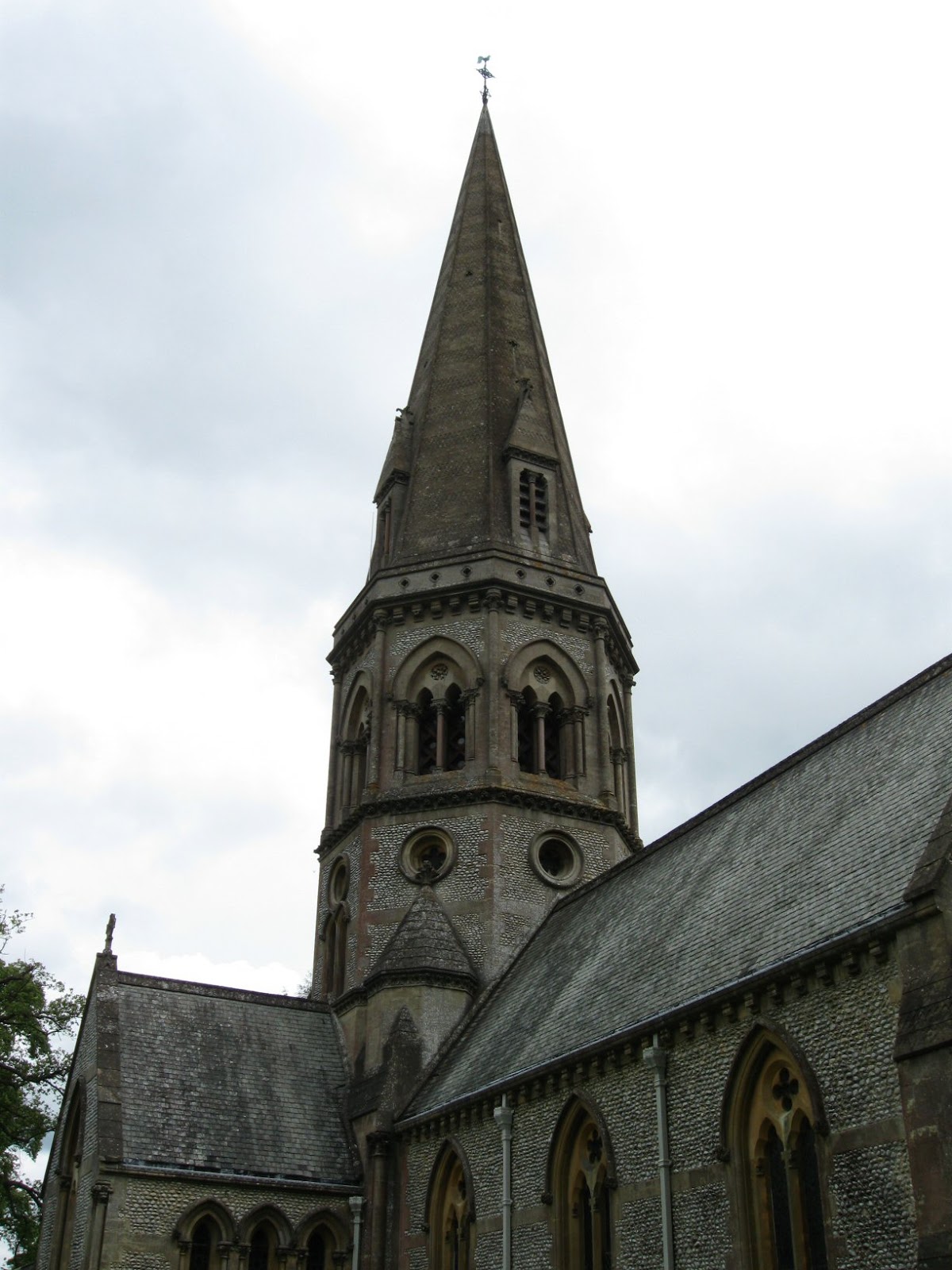
Follow the North Downs Way as it turns right at TQ 15124 50529 [D] and left at TQ 15091 50691 [E] on to Ranmore Common Road. Follow this, and if time permits spend a while looking at the Church of St Barnabas on the left.
Ranmore Common Road emerges from the trees at a junction at TQ 14355 50369 [F], the North Downs Way continues on the other side of the road - look for the footpath post immediately opposite.
Follow the path around to the right, and then straight ahead into the trees. There are further good views of the valley over to the left.
![]() |
| Ranmore Common |
There are in fact three paths leading away from here, this walk takes the middle one, signposted for the Youth Hostel at Tanner's Hatch. At the Youth Hostel, follow the path round to the right at TQ 14009 51552 [I].
Soon after emerging from the trees, there is a junction of paths at TQ 14423 51730 [J]. At this point, it is possible to branch off and visit Polesden Lacey, see the note below for this extension.
Bear right across open land to Bagden Farm, and then left to meet Chapel Lane at TQ 14802 52093 [K]. From here, follow Chapel Lane back towards Westhumble. Note that the lane is winding and narrow, and
difficult in places, but it is nevertheless possible to walk straight back into Westhumble this way.
Alternatively, take a right turn on to Ranmore Common Road, and then take the footpath off to the left at TQ 15246 51946 [L], following this upwards and keeping to the left - the footpath continues across a style and alongside the edge of the trees. Cross another style and then follow the path as it bears to the right.
At the footpath junction at TQ 15871 51622 [M] turn left, and then look for the footpath on the right at TQ 16028 51856 [N]. Rejoin Chapel Lane, and follow it back into Westhumble.
![]() |
| Italianate Bridge |
Note that it is possible to enter the grounds from this road, by following it to the gate and entering at TQ 14209 51964 [P], but it is possible to access the visitor centre and facilities without buying a ticket for the house and grounds, there is a gate to the right at TQ 14248 51952 [Q] before reaching the boundary gate. Keep following this path around the boundary, through two gates at TQ 14067 52280 [R], bear left around the edge of the trees at TQ 13950 52481 [S] before finally meeting the entrance road at TQ 13699 52384 [T].
From there, the main entrance is ahead and on the left.
To rejoin the walk, head back to the Italianate Bridge, and continue on the road, which winds down to Bagden Farm. Pass through the gate to the left of the main gate and on to Chapel Lane.
Wednesday, 28 December 2011
52 Weeks 52 Photos
I did find some web projects running where the aim was to take a photograph every week in order to build up the collection. Whilst this is interesting, most years have some weeks which, frankly, shouldn't be recorded for posterity, and I'm sure this year is no exception. So this does cover 12 months, but not very evenly.
Click here to view the Picasaweb album
Subscribe to:
Posts (Atom)